
Dodo Pizza: AI handles 80% of customer requests
30%
Faster issue resolution
$0.13
Saved per request
25%
Support payroll savings

Dodo Pizza is the #1 pizza chain in Russia by active restaurants. The company operates 1,073 outlets across 22 countries beyond Russia. Per month, agents handled requests from 120,000 unique users. The partnership with Lia ended in June 2026.
About the project
The pizza chain started working with us in mid-2021. Lia's job was to reduce agent load and stop the headcount inflation driven by rising request volume. The result: Dodo Pizza's team is 15% smaller than it would otherwise be, and every contact Lia closes costs 10 RUB less.
Starting point
Before our partnership, Dodo Pizza routed every message to an agent. At peak times, the human factor dragged response quality down and stretched resolution time.
Heavy agent load drove churn and constant backfill — pushing up HR cost.
As volume grew, the company kept hiring — payroll and customer-care operating cost climbed.
At peaks, wait time stretched from 1 to 15 minutes, eroding satisfaction. Negative reviews about delays hit Dodo Pizza's reputation, where speed is a core brand promise.
Goals
Reduce request handling cost.
Cut agent payroll without losing quality.
Lower agent load and lift team engagement.
Solution
Analyzed Dodo Pizza's customer-request corpus and surfaced the most frequent queries.
Split all requests into topics (e.g. "When will my order arrive?").
Loaded each topic with 50+ different phrasings of the same question, including grammatical errors and typos.
Trained Lia to handle requests against the script structurally and sequentially, so her text felt as close to a Dodo agent as possible.
Integrated Lia with the Edna chat platform, which the customer was already using.
Trained Lia to close the most common product, order-status, and store-hours questions on her own. Lia resolved 28% of requests with no human involvement.
Automated 75% of in-app requests; only 25% went to a human agent.
Set up topic-based routing. The tool helps the agent grasp context fast and forward the conversation to a specialist trained for that issue.
Built dynamic scenarios so Lia can change a delivery address on customer request, change order status ("in progress", "out for delivery"), or change order type (from delivery to pickup).
Implemented an alert mechanism: a tool that sends customers a notice during mass outages. For example, when payments are failing, the Dodo bot greets the customer along with a follow-up like "Sorry — payments are having issues right now, please try again later." This single mechanic absorbs a huge volume of requests and handoffs. At peak load, the bot sends a warning alongside the greeting that connecting to an agent will take longer than usual.
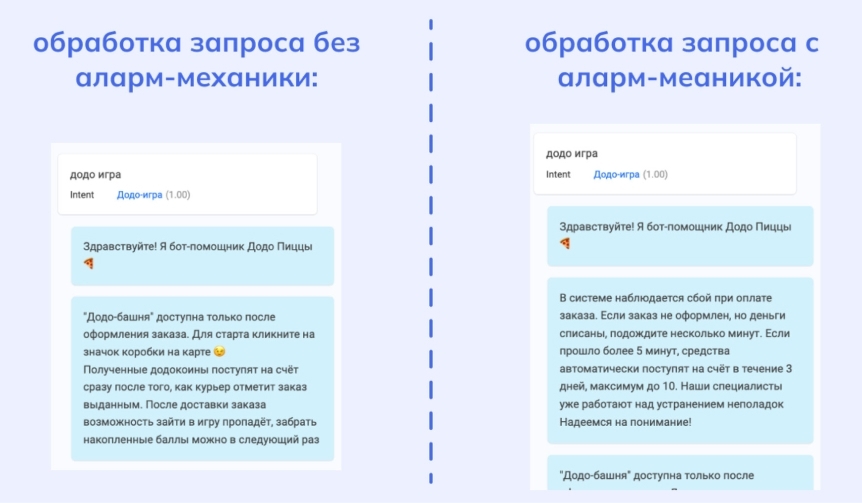
Lia before and after the alert mechanic was deployed
Built a primary-info collection step before agent handoff — speeding up resolution on every customer request by 40%.
Combined the menu pick of common questions in the Telegram bot with free-text entry, so customers reach an answer fastest by either path.
Continuously update the bot scenarios with current Dodo Pizza promotions before they go live.
Run ongoing fine-tuning, expanding topics and scenarios Lia can handle.
Edna integration
Dodo Pizza was already running on the Edna chat platform and receiving all inbound requests through it.
Our specialists connected Lia to Edna and tuned the AI inside the Dodo Pizza app.
In the first month after launch, coverage (sessions without an agent + sessions with scripted handoff to an agent) was 48% — and within a few months it climbed to 75%.
Building the project on top topics
1. The team built the Dodo Pizza chat bot in stages:
Processed the pool of most frequent customer questions
Analysts dissected the original request corpus and surfaced the highest-frequency queries.
To teach Lia to map the same request — phrased differently — to the same intent, analysts split everything into topics.
20 topics were defined, including:
How to change the delivery address
Until what time does delivery run
How to cancel my order / cancel my order
Wrong delivery address / mixed up the address
Where is my order / order status
And others.
Conversation scenario for the "Dodo game" intent
2. Trained Lia to answer like an agent
Analysts studied every script Dodo Pizza agents worked from and reflected them in the bot's logic. This let Lia answer requests across all scenarios structurally and sequentially. Her text felt as close to a Dodo agent's voice as possible — many customers couldn't tell whether they were talking to a human or a bot. That increased trust in the support team.
3. Trained Lia to recognize text with errors and typos
We loaded each topic with 20+ variations of the same question. That let Lia identify intent on her own, even when grammar slipped or typos crept in.
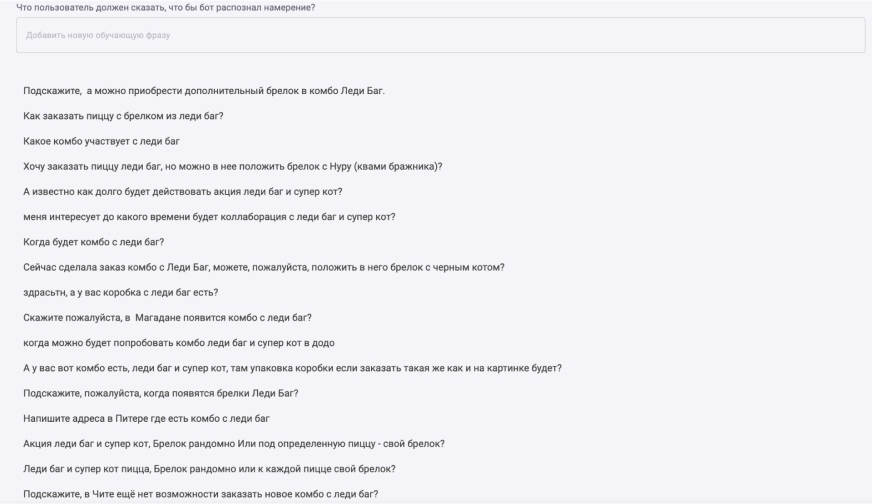
Variations covered by the "Lady Bug promo" intent
Across a project's lifetime, intents grow to 100+ phrasings each, raising recognition accuracy.
Fine-tuning existing topics and labeling new ones
Three years after Lia went live, our specialists are still analyzing the conversations where the bot didn't manage to handle the request or escalated by script. Those conversations drive the ongoing tuning.
For example: Lia originally didn't answer questions about which payment cards were on file. Today she handles those, and if the customer has more clarifications, she transfers to an agent.
Lia keeps getting smarter — when the same retrained request comes in next, she handles it on her own without a human.
After Lia went live, Dodo Pizza's leadership measured the unit economics — the cost of an agent-handled request by topic. The company saved 10 RUB per request, cutting customer-care operating cost by over 1,000,000 RUB per month at 120,000 unique users.
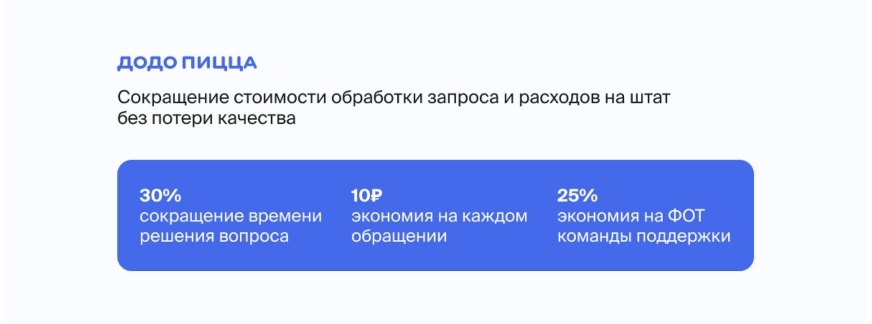
Dodo Pizza's unit-economics impact after Lia went live
Since 2021, Lia has been saving Dodo Pizza's customer-care time and accelerating customer interactions — freeing managers to work on higher-value tasks.
Building dynamic scenarios
Static scenarios are something Lia handles autonomously: she returns a text answer or transfers to an agent. Dynamic scenarios, by contrast, hit an API to resolve the issue.
Dynamic scenarios are implemented with JavaScript snippets — they call Dodo Pizza's admin via API, fetch the needed info, and process it.
Examples of dynamic scenarios at Dodo Pizza:
Order status.
Delivery address change.
Order type change (delivery → pickup).
Hours lookup.
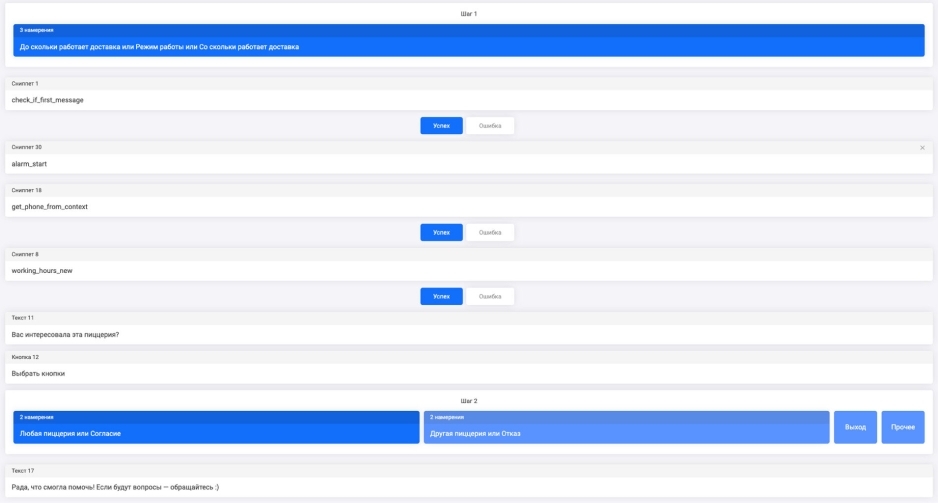
Dynamic scenarios are implemented by exposing the necessary API methods on the customer side and writing JavaScript snippets.
Results of Lia's deployment
Dodo Pizza's team chose Lia for the best-fit feature set, speed, and ease of integration with the chat center.
Customer-communication automation at Dodo Pizza was delivered turnkey by our specialists. We owned business-process analysis, AI bot development, static and dynamic scenario authoring, integration, and tuning Lia from scratch.
Today Lia is used in the customer-support team to gather primary information about a customer's issue before handoff to a human.
Lia is integrated into the chat center, so beyond answering customers, she segments requests for downstream routing. That capability matters for the several in-house bots Dodo Pizza runs in internal services and ticket systems.
To keep Dodo Pizza's oversight on Lia, a support specialist, business analyst, and account manager are involved in her ongoing operation. They track CSAT on bot answers and steer adjustments accordingly.
With Lia in place, Dodo Pizza handles more requests without scaling support headcount. Resolution speed on most common questions is up — driven by automating answers through Lia and integrating her with the internal CRM.
If you don't want to fall behind market leaders, switch to AI-powered chat work now. Lia's typical implementation in mid-market and SMB takes about 3 days; the investment recoups within the first 2–3 months.
For a free consultation with our team, leave a request in the form below. Our manager will follow up on a video call at your convenience and:
identify bottlenecks in your sales operation;
walk through which processes Lia can optimize;
break down how Lia helps you grow margin;
explain pricing tiers and implementation options for your business.