
Whoosh: Each request costs 3x less to process via Lia
63%
Of requests automated
×3
Saved per request

Whoosh is a kick-scooter rental service operating in 59 Russian cities. As of June 2024, the platform has 23.9M registered accounts — up 57% year-over-year. Annual rides exceed 55.3M, and support agents handle requests from an average of 290,000 unique users a month.
About the project
The kick-sharing service came to us in February 2021. With Whoosh scaling continuously, the company was looking for ways to avoid inflating the support team and to cut request handling cost. After Lia's deployment, the cost per request resolution dropped 3×, and 63% of requests close without a human agent.
Starting point
Whoosh's brief: cut headcount-growth costs and per-request handling cost without losing quality, against the backdrop of constant scaling and customer acquisition.
The company made a massive jump in 2020, attracting record customer volume — 5–6× prior years. Agents couldn't keep up with messages and complex case resolution.
As the customer base grew, Whoosh kept expanding the agent roster, putting heavy strain on HR for sourcing and pushing payroll up.
Per-request cost rose every month as request volume and topic diversity grew with the company.
Goals
Cut payroll spend.
Stop headcount inflation.
Reduce per-request cost without losing quality.
Solution
Pulled and analyzed the customer-request corpus from recent months.
Surfaced the most frequent repetitive customer requests — the ones agents were losing motivation answering.
Authored response copy for every scenario in the brand's tone of voice and implemented them in Lia's chat bot.
Trained Lia to identify customer intent even when messages had errors or stuffed multiple known questions into one.
Built scenarios where Lia handles requests for adding new parking zones and expanding existing ones.
Trained Lia to help users with subscription info, parking rules, and ride-end specifics.
Request and process analysis
To train the AI, we ingested several thousand phrasings from Whoosh agent–customer interactions.
Omnidesk integration
Our specialists connected Lia and tuned the AI for the support chat in the Whoosh app. Coverage reached 60% counting Lia's autonomous handling and scripted handoffs to agents.
Building the project on top topics
The Lia-for-Whoosh project ran in stages:
Grouped customer questions into intents
Analysts isolated repetitive questions in their various phrasings and split them into intents. A single topic typically aggregates 50+ phrasings — including misspellings or colloquial wording.
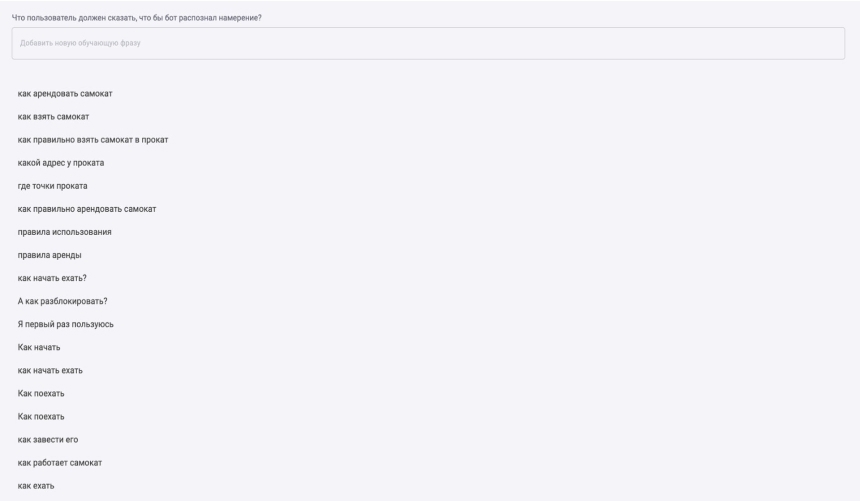
Question phrasings inside the intent containing the welcome information
Analysts split every request into topics, each containing 50 or even 100 phrasings of the same question — including errors and typos.
Authored response scripts (scenarios) for every intent and shipped them into Lia
Our team studied the scripts Whoosh agents worked from and, alongside the customer, wrote new copy for typical messages. The brand tone of voice was preserved, making the conversation with Lia as close to talking to a human agent as possible. Many customers didn't immediately realize they were talking to an AI helper, not a person.
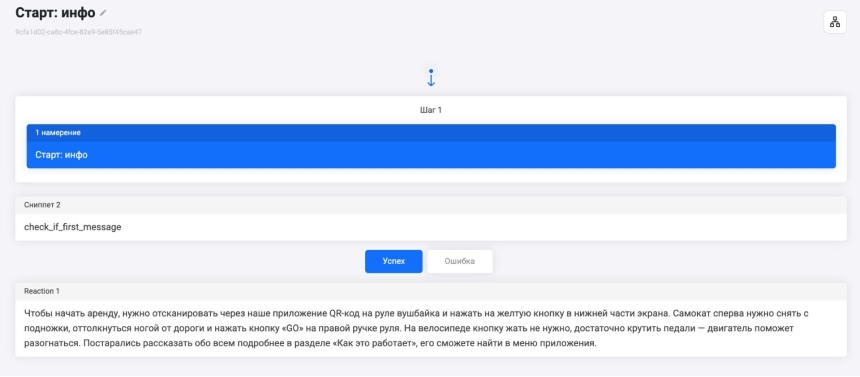
Question phrasings inside the intent containing the welcome information
Configured topic-based routing
Our team studied the scripts Whoosh agents worked from and, alongside the customer, wrote new copy for typical messages. The brand tone of voice was preserved, making the conversation with Lia as close to talking to a human agent as possible. Many customers didn't immediately realize they were talking to an AI helper, not a person.
Fine-tuning existing topics and labeling new ones
By splitting all requests into specific intents, we deployed routing — search and navigation through specific topics. That helped Whoosh collect statistics on which questions hit Lia most often, and where (which districts or cities) the most frequent scooter or parking issues originated.
After AI deployment, all text-channel work happens inside the Edna chat platform. Every customer request from the app lands there.
At level 1, every request is handled automatically. Whoosh specialists can review every bot-handled request.
At level 2, if Lia couldn't answer or the customer wanted a human, the conversation routes to the right specialist.
The customer can always choose to chat with a live agent — they're routed to the right specialist after a few clarifying questions.
The agent immediately sees the full conversation history with the bot. No need to ask clarifying questions — they go straight to the issue. The agent replies inside Edna; the response is forwarded to whichever channel the customer wrote from — for instance, the app. If this isn't the customer's first contact, the agent sees that too — the request history is shown in the dialogue window.
Building dynamic scenarios
Since deploying Lia at Whoosh in 2021, we've continued to track messages where the AI couldn't answer on her own and/or escalated to an agent.
Analysts author response scenarios for questions that can be additionally automated, reducing Lia's handoffs to the kick-sharing service's staff. That cuts agent load and lifts engagement — people answer genuinely complex and non-standard cases, not the templated ones.
We also enable Whoosh specialists to add new intents themselves. For example, the bot now answers questions about wKey rides, depositing for a minutes package or refunding it, and similar.
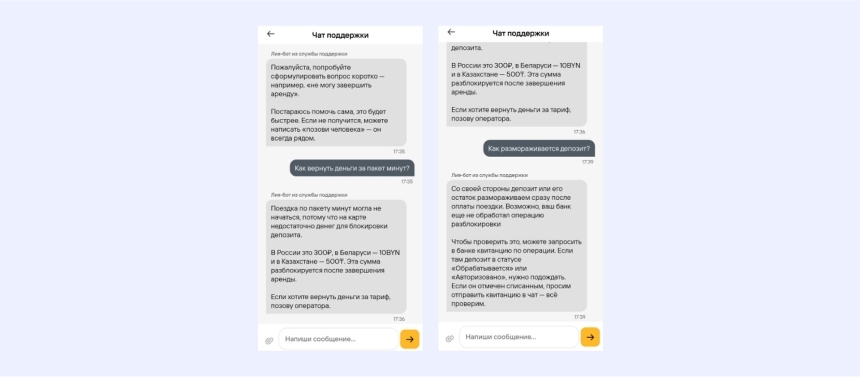
Examples of Lia's answers to user questions in the Whoosh chat
After Lia went live, Whoosh's leadership measured unit economics and found that handling one complex request costs at least 3× less. Lia's answers on simple, frequently asked questions are dramatically cheaper than agents handling them.
Results of Lia's deployment
The Lia-into-Whoosh-bots project was delivered turnkey by our specialists.
From the customer we needed only the request corpus from the past few months — that's what we analyzed to surface user questions and split them into scenarios.
Everything else was on us — from development to deployment. Whoosh specialists didn't touch configuration or technical issues — they got working customer-comms tools out of the box. During the fine-tuning stage of the AI bot, Whoosh analysts added new intents and answers with our help.
With Lia, Whoosh handles more customer requests without scaling support headcount. During one peak season the company hired 90 fewer agents than it otherwise would have. The AI answered questions multiple times faster than any agent and handled several requests in parallel — not always possible for a human.
Resolution now costs Whoosh 3× less. Agents stopped living in constant stress and are pulled into conversations only for non-standard customer issues.
Roadmap
Whoosh saw Lia's effectiveness and plans to expand her capabilities with our team.
The near-term priority is adding new topics for Lia to handle, based on Whoosh's requests.
When the AI bot encounters such requests, it identifies the topic on its own and serves it according to the configured algorithm — i.e. transfers to an agent. Whoosh specialists, alongside our analysts, regularly add new topics into the bot's logic.
If you don't want to fall behind market leaders, switch to AI-powered chat work now. Lia's typical implementation in mid-market and SMB takes about 3 days; the investment recoups within the first 2–3 months.
For a free consultation with our team, leave a request in the form below. Our manager will follow up on a video call at your convenience and:
identify bottlenecks in your sales operation;
walk through which processes Lia can optimize;
break down how Lia helps you grow margin;
explain pricing tiers and implementation options for your business.